Why Wholesome Children’s Books Matter More Than Ever

Have you ever experienced that moment when you share something deeply personal, something vulnerable, and realize it’s the only way to move forward?
That’s how I felt when I sent my new children’s book manuscript to my illustrator for the very first time.
Handing over a story like that feels a bit like handing over your heart: you just don’t know how it will be received.
So when she responded and said, “Its wholesomeness put a smile on my face,” I felt an almost instant wave of relief that she understood.
When Words Reveal Shared Values
After a bit of back-and-forth messaging, we scheduled a video call to talk through the project and take next steps.
I knew I had found something special the minute we started talking. And then, without prompting, Hannah described the manuscript again as a “wholesome story.”
That single word mattered more to me than she probably realized.
Yes, her talent and art style aligned beautifully with my vision. But even more than that, I had found someone whose values and discernment matched my own. Someone who recognized the heart behind the story before we ever discussed it out loud.
And if you’re a parent who values wholesome stories too, I want you to hear this clearly:
- You’re not “old-fashioned” for wanting them.
- You’re not overreacting to the content your children consume.
- You’re being intentional, and that matters.
But what do we actually mean when we say “wholesome stories”?
What Do We Mean by “Wholesome,” Anyway?
Let’s clear something up right away: wholesome does not mean boring, shallow, or sugar-coated.
To me, wholesome stories are:
- Stories that honor truth without being harsh
- Stories that don’t mock goodness or innocence
- Stories that leave hearts lighter, encouraged, rather than confused or stirred up with fear
A wholesome story is one you don’t have to “undo” later with a long explanation or damage control conversation.
It’s a story where honesty is honored instead of mocked, where courage is rewarded instead of ridiculed, and where goodness isn’t portrayed as naive.
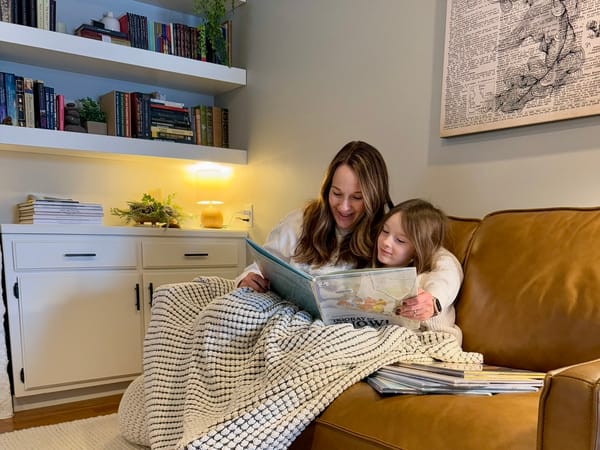
In our home, we try to weave books into the rhythm of daily life through read-alouds during homeschool, quiet moments in the afternoon, bedtime stories at night, audiobooks on the road. And what those stories plant matters.
How to Recognize a Wholesome Children’s Book
If you’ve ever stood in the library or bookstore wondering, “How do I know if this is a good fit for our home?” here’s a simple filter you can use:
When evaluating a children’s book, ask:
- Does this story reward kindness, courage, honesty, or self-control?
- Are parents and authority figures treated with respect?
- Is goodness portrayed as admirable or foolish?
- Does the conflict resolve with peace, growth, or redemption?
- After reading it, does my child feel encouraged and stirred with a sense of wonder?
Wholesome stories don’t have to be perfect or unrealistic. They can include struggle and tension. But they ultimately point toward truth, hope, and what is worthy of praise.
It’s less about controlling what they read and more about guiding what takes root.
Philippians 4:8 as a Filter for Stories
If there’s one verse that serves as a steady filter for the stories we bring into our home, it’s Philippians 4:8:
…whatever is true, whatever is honorable, whatever is just, whatever is pure, whatever is lovely, whatever is commendable, if there is any excellence, if there is anything worthy of praise, think about these things.
Stories shape what our children think about. Repeated exposure forms imagination, values, and worldview.
We see this clearly in much of modern children’s entertainment, where disrespect is played for humor and right and wrong are often blurred.
We’re not just filling time when we hand our kids a book or turn on a show. We’re forming hearts.
Choosing wholesome stories isn’t about restriction. It’s about direction.
Why This Matters for Families Who Write Their Own Stories
When families write stories together, they’re practicing Philippians 4:8 in real time.
Parents become the curators, not just consumers.
Children learn that creativity and discernment belong together and that imagination doesn’t have to be separated from truth.
It can be as simple as asking a few questions while writing:
- Is this kind?
- Is this necessary?
- Does this point toward truth or hope?
And we make room for imperfect starts along the way. What a gift for our kids, and for us, to remember:
You don’t need perfect words. You just need a willing heart.
Stories as an Act of Obedience
So, I’ll say it again: Wholesome stories are not small or insignificant.
For our family, and in our growing work at Pathfinder Press, we’ve come to see wholesome stories as an act of stewardship, a way to pass down what matters, one story at a time.
In a noisy world, choosing what is lovely and worthy of praise is a quiet kind of obedience, and God meets us there.
I’d love to hear from you:
What does “wholesome” mean in your home?
What draws you back to the books you reach for again and again?
If you feel even a small nudge to write a story your family would be proud to pass down, I’d love to have you to follow along at Pathfinder Press. We’re learning and building this one story at a time.